Doctoral Students
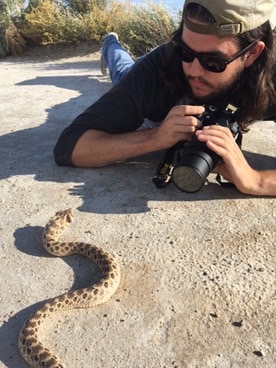
Craig Fischer
I have long been interested in myriad aspects of ecology, using my bachelor's in Biological Sciences from Marquette University and bio tech positions in public lands to ask pointed questions about effects of climate change, habitat alteration, and recreation on ecology of public lands. Four years working in the Colorado Desert have given me ample opportunity to develop questions regarding the ecology of this remarkable region. My research focuses on how natural and anthropogenic landscape factors may affect genetic diversity of flat-tailed horned lizards (Phrynosoma mcalli) within an off-road focused recreation environment. Email: craig.g.fischer@gmail.com
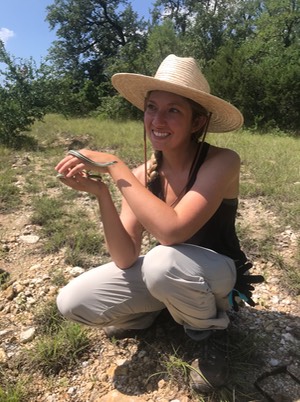
Kristin Kabat
I received my B.S. in Conservation Biology and Ecology from Arizona State University and my M.S. in Natural Resources Management from Texas Tech University. For my masters research I developed an environmental DNA (eDNA) detection method for cryptic terrestrial reptiles. The majority of my research has focused on the distribution, conservation and behavioral ecology of herpetofauna populations throughout Arizona, New Mexico, and Texas. I worked on the USGS Brown Treesnake Project on Guam and have interned with the Arizona Game and Fish Department and the National Park Service. For my dissertation research I am planning to link animal-borne accelerometry with respirometry to evaluate the relationship between movement and energy use across snake taxa. Email: kkabat0439@sdsu.edu
Masters Students

Harshita Vallabhenini
I received my B.S. in Biology from San Diego State University, where I worked in Dr. Clark’s lab as an undergraduate research assistant on multiple projects and developed a passion for ecology and animal behavior. My current research focuses on the movement ecology and translocation outcomes of the Red Diamond rattlesnake (Crotalus ruber) in collaboration with the San Diego Zoo Wildlife Alliance, with an interest in understanding how individuals respond to landscape modification and management interventions. I am also conducting a comparative study of rattlesnake rattle morphology across San Diego County to examine whether increasing urbanization over the past century has influenced growth patterns and body size in Southern Pacific and Red Diamond rattlesnakes. This work uses museum specimens from the SDSU Biodiversity Museum and the San Diego Natural History Museum, comparing historical (pre-1950) and contemporary samples from the same regions. Email: hvallabhaneni5225@sdsu.edu

Vincent Marcantonio
I received my B.S in Biology with an emphasis in Zoology from San Diego State University. During my time at San Diego State, I worked in Dr. Clark’s lab on a variety of projects that allowed me to continue to expand and strengthen my interest in the field of ecology and conservation. My current research focuses on the conservation ecology and behavior of threatened reptile species in Southern California, particularly on how anthropogenic pressures such as habitat fragmentation and human disturbance influence animal behavior and ecological function. I aim to use animal-borne accelerometry and radio telemetry to link behavioral and spatial responses to broader conservation challenges in an increasingly urbanized landscape. Through this project, I hope to further inform management and conservation strategies, while promoting coexistence between humans and venomous snakes. Email: vmarcantonio6224@sdsu.edu
Leah Carpenter
I completed my B.S. in Biology at San Diego State University, where my time in Dr. Clark's lab allowed me to explore my interests in conservation ecology and animal behavior. As an aspiring wildlife veterinarian, I am interested in how individuals under environmental stress connect to the broader context of biodiversity loss. I currently work with the flat-tailed horned lizard (Phrynosoma mcallii), a California species of special concern. Using temperature-sensitive accelerometry, I aim to describe fine-scale behavioral patterns and investigate how increasing environmental temperatures impact the ability of the species to efficiently thermoregulate and perform critical behaviors. Collaborating with local wildlife biologists and high school students, my project seeks to promote the Flat-tailed horned lizard as a flagship species for the Colorado Desert region, fostering appreciation and support for its conservation. Email: lcarpenter9317@sdsu.edu
Graduate Student Alumni
Matthew Barbour, MS 2012, Investigating the function of California ground squirrel (Otospermophilus beecheyi) displays towards northern Pacific rattlesnakes (Crotalus oreganus)
Frank Santana, MS 2013, Mountain yellow legged frog (Rana muscosa) conservation: multiple approaches
Shannon Hoss, PhD 2013, Maternal attendance of young in cottonmouths (Agkistrodon piscivorus): Adaptive value and hormonal mechanisms
Laura Kabes, MS 2014, The use of chemical cues by granite night lizards (Xantusia henshawi) to evaluate potential predation risk
Bree Putman, PhD 2015, The function and ontogeny of antipredator responses: the influence of snakes on ground squirrel behavior and physiology
Tara Luckau, MS 2015, Comparative conservation genetics of two sympatric lizard species across multiple landscapes in San Diego County
JP Montagne, MS 2015, The effect of personality on movement and survival following translocation of California ground squirrels (Otospermophilus beecheyi)
Kelly Lion, MS 2016, A comparative study of genetic patterns in two closely related and sympatric Peromyscus species
Stephen Rice, PhD 2017, Conservation genetic assessment of the Island Night Lizard, Xantusia riversiana, under contemporary and future environmental conditions
Hannes Schraft, PhD 2019, Behavioral and ecological implications of infrared sensing in rattlesnakes
Kelly Robinson, MS 2019, Biochemical warfare: coevolution of venom and venom resistance among rattlesnakes (Crotalus oreganus helleri and C. ruber) and mammal prey (Otospermophilus beecheyi and Neotoma bryanti)
Malachi Whitford, PhD 2020, Determinants of predation success: a holistic examination of the predator-prey interactions between rattlesnakes and kangaroo rats
Grace Freymiller, PhD 2021, Factors that influence the performance of complex behaviors in a terrestrial vertebrate: variability in the kangaroo rat evasive leap
Roman Nava, MS 2022, Changes in morphology and behavior of the Coronado Island rattlesnake (Crotalus oreganus caliginis), an insular population of the Western Rattlesnake (C. oreganus)
Nathan Smith, MS 2023, Changes in morphology and behavior of the Coronado Island rattlesnake (Crotalus oreganus caliginis), an insular population of the Western Rattlesnake (C. oreganus)
Jessica Hill, MS 2023, Investigating the potential for warming temperatures to disrupt preadator-prey interactions at different spatial scales
Dylan Maag, PhD 2023, How does behavior impact hybridization dynamics in systems lacking significant prezygotic isloating mechanisms? A case study of free-ranging rattlesnakes across a hybrid zone.
Emma McAndrews, MS 2024, Integrating novel and traditional field technologies to quantify the activity cycles, behavior, and spatial ecology of a California species of special concern, Crotalus ruber.
Ryan Hanscom, PhD 2024, From ambush to activity: using accelerometry to reveal cryptic behaviors of rattlesnakes and kangaroo rats.